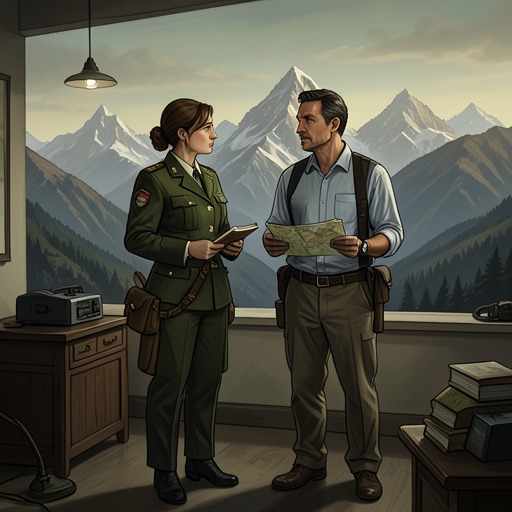
Kristín and Steve rebuild trust and consider rekindling their romance
Operation NapoleonKristín and Steve rebuild trust by separating their private feelings from the military presence that had come between them. Their renewed closeness takes shape during a dangerous journey: Steve helps her without demanding repayment, and Kristín comes to see that her opposition is directed at the American army in Iceland, not at him. Their reconciliation culminates in a kiss and a proposal to try again once the immediate crisis is over, leaving the relationship newly possible but unresolved.
An earlier rupture
The relationship carries the weight of a break neither has forgotten. As they travel from Reykjavík, Steve sits mostly silent, watching the white road ahead. After a stretch without conversation, he asks whether Kristín has thought about him since she ran out on him. Her answer—that she has, from time to time, and tried to explain—acknowledges both the continuing attachment and the failure of her earlier explanation to settle matters between them.
Steve recalls her refusal in the humiliating language of a woman who did not want to become a GI’s lover. Later, he refers to her as a peace protester who had become a Yankee’s lover. The labels make clear how the breakup joined intimacy to a political conflict: Kristín’s withdrawal was not simply a judgment of Steve, but neither could he experience it as impersonal. Their teasing is edged with weariness rather than ease. The past remains present in the car, where a question about whether she has thought of him opens a conversation they have postponed.
Politics and personal distinction
Kristín explains that her objection is partly political. She opposes the American army’s presence on Midnesheidi; although she can understand its strategic importance during the Cold War, she regards the base as a blot on the landscape. She believes Iceland should have no army and objects to the country becoming entangled with one. Her criticism extends beyond the military itself to Icelanders, particularly businessmen, whom she believes have prostituted themselves to the Defense Force. She admits that she should not have let her relationship with Steve go so far, but struggles to put the distinction into words.
Steve’s response identifies the distinction she is trying to make: he is not the American army on Midnesheidi. Kristín agrees that she knows this, and considers whether they moved too quickly and should have known one another better first. Steve, in turn, begins to describe himself more precisely. He corrects the broad identity of a New Yorker by saying he is from Albany, New York, and invokes William Kennedy as a reference point. The exchange lets him insist on an individual identity within the larger national presence she resents; it does not erase her political convictions, but makes room for her to regard him as more than their emblem.
Help, respect, and renewed intimacy
The immediate crisis alters the balance between them. Kristín tells Steve that he could have refused to help her and left her to manage alone; she feels she does not deserve favors from him. His joking reply about a damsel in distress allows her to answer in kind, calling him a knight in shining armor. Beneath the playful exchange is a concrete change: his assistance has been freely given, and she recognizes the choice involved rather than treating it as his obligation.
Steve’s private response deepens that recognition. He admires Kristín’s courage and loyalty to her brother, her refusal to be cowed by superior forces, and her ability to elude those trying to kill her. She is now undertaking a difficult, dangerous journey with an uncertain outcome. He sees in her a strength that had been present from their first meeting but had not yet fully emerged in his understanding of her. His attraction grows through witnessing what she does under pressure, not through a denial of the danger surrounding her.
Kristín, for her part, says that the events of the preceding twenty-four hours have not made her hate Americans. Her objection remains specifically to an army on Icelandic soil. She is anxious not to drive Steve away and acknowledges his stoicism, courage, and capacity for understanding. The distinction between a political institution and an individual is therefore mutual: Steve asks not to be mistaken for the army, while Kristín makes clear that opposing its presence does not mean rejecting him as an American.
A tentative beginning
When Steve asks why she let their earlier relationship go so far, Kristín says that she had no doubts about him until the evening on the base. She suggests that the time and place, and her own need for more time to adjust to the situation, overwhelmed her. She insists that the rupture was not his fault, attributing it instead to what she calls the military. Her account does not make the earlier decision disappear; it gives Steve a more personal explanation for a rejection he had experienced through the language of national and sexual insult.
After Steve suggests that they rest, Kristín thanks him for being there and says she does not know how she would have coped without him. He begins to say that he had always hoped they might find their way back to one another, then breaks off before finishing. Kristín supplies a future-oriented possibility: when everything is over, they can try again and see what happens. Steve nods, and she kisses him. Her subsequent reference to the friendship between their two nations turns their political difference into an intimate joke, even as the kiss makes the renewed attraction unmistakable.
The scene ends with a second kiss and Kristín beginning to undo the zips of Steve’s winter clothes. She recognizes the wartime impropriety of the moment and chooses not to heed that inner warning. Yet the encounter is not a settled romantic resolution: the promise is conditional on the crisis ending, and their future is left open. The relationship’s decisive change is narrower and more credible—the old rupture has been spoken about, each has been seen more clearly by the other, and both have allowed the possibility of beginning again.